How to Light a Patio: Solar, String, and Path Lights
June 28, 2026
A patio with the right lighting earns its keep after dark. The mistake most people make is reaching for one bright fixture and calling it done. A single floodlight over the seating flattens the space, throws hard shadows, and does nothing for the steps or the walk to the door. The fix is a few kinds of light, each handling a different job. Here is how to plan it.
Think in layers
Lighting designers work in three layers, and the same idea works on a patio.
- Ambient light is the general glow that lets you see the whole space and move around without squinting. Overhead string lights are the easiest way to get it outdoors.
- Task light covers the spots where you actually do something, like a grill station or the steps down to the lawn. It is brighter and more focused than the ambient glow.
- Accent light is the finishing touch, small pools aimed at a tree, a planter, or a wall. It adds depth and keeps the yard from dropping into a black wall past the seating.
You do not need all three on day one. Start with ambient over the seating, then add task and accent later.
String lights for the main glow
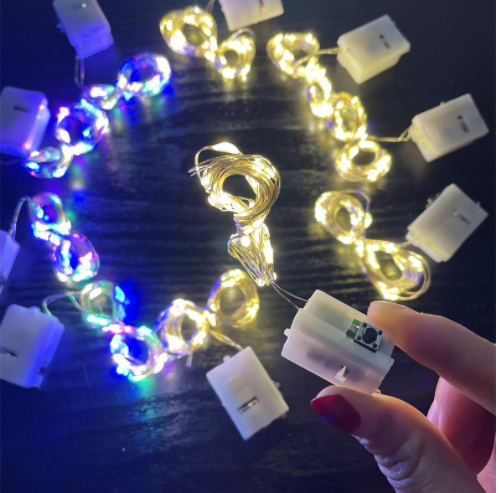
String lights do most of the work on a patio, and they are the layer worth getting right first. Run them above the seating area, either straight across, in a zigzag for a wider canopy, or around the perimeter to frame the space.
Measuring the run matters more than people expect, because a short cord leaves you splicing extensions and a long one piles up in a tangle. Mark your hanging points, run a tape measure point to point along the path the lights will follow, and add about one extra foot of slack for every ten feet so the strands drape into a gentle swag instead of pulling tight. For longer spans, hang the lights from a guide wire so the cord itself carries no weight.
A few things to check before you buy:
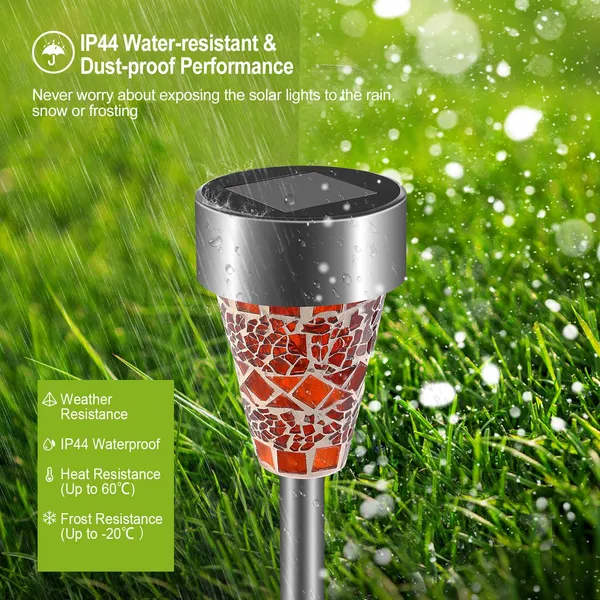
- Look for a weatherproof rating of IP44 or higher. The first digit covers dust and the second covers water, so IP44 handles splashing rain while IP65 stands up to direct spray from a hose or a storm.
- Warm white bulbs around 2700K feel relaxed and flatter skin and food. Push past 4000K and the light turns cool and clinical.
- Shatterproof plastic or silicone bulbs survive a dropped patio umbrella far better than glass, and LED strands sip power and stay cool to the touch.
You can see weatherproof sets in the string lights collection.
How bright, and what color
Brightness is measured in lumens, not watts, and outdoors you generally want less than you think. A seating area feels right with soft, low ambient light, because your eyes adjust and a glare bomb ruins the mood. A grill or a stair landing wants a focused 200 to 400 lumens so you can see what you are doing, while path lights sit lower still, often 1 to 20 lumens each.
Color temperature, listed in Kelvin, sets the feel. Lower numbers are warmer and more golden, higher numbers whiter and bluer. For anywhere people relax, stay in the 2200K to 3000K range, and save the cooler 4000K and up for security and work lighting.
Solar, low-voltage, or plug-in
How a light gets its power shapes where you can put it and how much work it takes to install.
- Solar is the simplest option for paths and corners far from any outlet, since there is no wiring at all. Each fixture charges through a small panel by day and switches on at dusk. The catch is that it needs real sun, so a panel under a deep awning or a north-facing wall gives a weak glow, and solar runs dimmer than wired options.
- Low-voltage systems run a transformer off an outlet down to 12 volts, then feed a buried cable you tap fixtures into anywhere along its length. This is the workhorse for serious landscape lighting: brighter and more reliable than solar, safe to handle, and you can trench the cable in yourself.
- Plug-in line voltage means standard 120-volt fixtures and string lights off your outdoor outlets. It gives the most brightness and least fuss near the house, but every cord has to reach a protected receptacle (more below).
The solar lights collection has stake, path, and wall styles for the spots without an outlet.
Spacing path lights so they actually guide
Path lights have one job, marking the safe route, and the most common error is lining them up like a runway. As a rule of thumb, set them 6 to 8 feet apart and stagger them side to side rather than in a straight facing row, which gives overlapping pools of light with natural-looking gaps between. Place a fixture at every real hazard: the top and bottom of a step, a sharp turn, the lip of a retaining wall. Aim the light down at the ground so it lights the path instead of glaring at whoever walks up.
Timers, sensors, and smart control
Most solar lights handle control on their own with a built-in dusk sensor. For plug-in and low-voltage setups, a few options save you from flipping a switch:
- Photocell sensors switch the fixtures on at dusk and off at dawn, so the lights track the seasons on their own.
- Timers, either a dial unit at the outlet or a smart plug, set on and off times, handy if you want the patio lit until midnight but not all night.
- Motion sensors suit security and task lights, staying dark until something moves.
- Smart plugs and bulbs add phone control, dimming, and schedules, so you can dim the strings or turn everything on before you get home.
Floodlights for security and big spaces
For a driveway, a large yard, or a dark side gate, a brighter floodlight covers ground that string and solar lights cannot. Motion-sensor models switch on only when something moves, which saves power. Mount them high and angle them down, and keep them out of the seating area, where their harsh light fights the glow from the strings.
A simple plan to start
For most patios, start with one run of string lights over the seating, add a handful of solar or low-voltage path lights along the walkway, and put a motion floodlight by the back door. Build the rest in layers from there: an accent fixture on a favorite tree, a task light by the grill, a smart plug so the strings come on by themselves. Once the lights are sorted, the outdoor furniture collection has the chairs and loungers to enjoy them from.
Keeping it working through the seasons
Outdoor lights live a hard life, so a little upkeep goes a long way. Wipe the solar panels every few weeks, since a film of dust or pollen cuts the charge and dims the light long before the unit fails. Swap any dead string-light bulb promptly, because one failed bulb can drag down a whole strand on some sets. Before winter, bring in anything not rated to stay out, coil the strands loosely, and store them dry. Trim back branches that block a path light or a panel.
Stay safe with outdoor power
A few habits keep outdoor power safe. Plug lights and cords into an outlet protected by a ground fault circuit interrupter, or add a portable GFCI if your outdoor outlet is not protected. Use only lights and cords rated for outdoor use, and look for a mark from a recognized testing lab. Inspect cords for cracks before each season, keep connections off the ground and out of standing water, and switch everything off before bed. The U.S. Department of Energy has a useful primer on outdoor lighting and controls, and the Electrical Safety Foundation has a short outdoor checklist worth a read.
Helpful resources
- Electrical Safety Foundation: outdoor decoration safety tips
- U.S. Department of Energy: outdoor lighting and controls